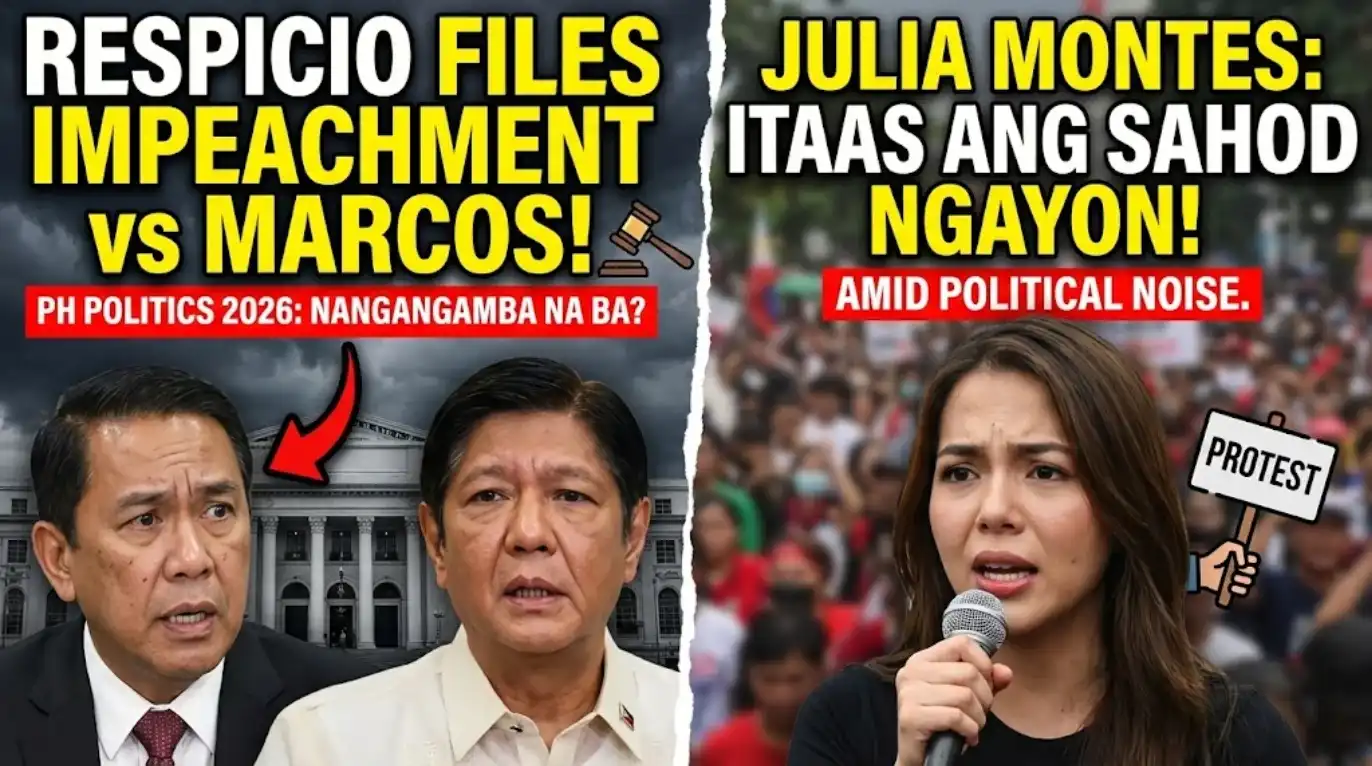
The first month of 2026 has ushered in a period of unprecedented volatility in Philippine politics, characterized by a dual crisis that strikes at both the highest levels of governance and the daily survival of the ordinary Filipino. While the corridors of the Batasang Pambansa are echoing with the heated rhetoric of impeachment complaints, the streets are buzzing with a different kind of demand—a plea for economic relief championed not by a politician, but by one of the country’s most beloved actresses.
The convergence of these two narratives—the legal offensive led by local officials like Vice Mayor Harold Respicio against President Ferdinand “Bongbong” Marcos Jr. (BBM), and the viral economic appeal from actress Julia Montes—paints a vivid picture of a nation divided. On one side, there is the high-stakes game of power, alliances, and constitutional challenges. On the other, the gritty reality of inflation, stagnant wages, and the struggle to put food on the table. This stark contrast has defined the national mood, creating an atmosphere of tension that many observers believe is reaching a breaking point.
The Respicio Impeachment Complaint: A Legal Firestorm
At the center of the political storm is the move to impeach President Marcos. The narrative took a sharp turn when a group of high-profile critics and local officials, including Reina Mercedes, Isabela Vice Mayor Harold Respicio, attempted to formalize their grievances against the Chief Executive. This was not an isolated incident but part of a broader fracturing of the political alliances that once dominated the 2022 elections.
Vice Mayor Respicio, a lawyer and vocal critic, has been at the forefront of a specific faction alleging that the administration has betrayed the public trust. The complaints circulating in the House of Representatives are multifaceted, but they zero in on highly sensitive issues. Primary among these are the allegations regarding the “unprogrammed appropriations” in the national budget—a technical term that critics argue masks a system of discretionary spending vulnerable to corruption. Respicio and his allies argue that the handling of the 2025 and 2026 General Appropriations Acts violates the Constitution, specifically in how funds are inserted and utilized without sufficient congressional oversight.
Furthermore, the complaint touches upon the controversial relationship between the Marcos administration and the International Criminal Court (ICC). The allegation that the administration might be facilitating or allowing the ICC to exercise jurisdiction over former President Rodrigo Duterte has enraged the Duterte support base, creating a strange bedfellow dynamic where local officials and former allies are now the President’s fiercest accusers.
Respicio’s involvement adds a layer of grassroots legitimacy to the complaint. As a Vice Mayor from Isabela—a region traditionally seen as part of the “Solid North”—his dissent signals that the cracks in the administration’s stronghold are deepening. His arguments often echo the sentiments of Senator Imee Marcos, particularly concerning the President’s fitness for office and the erratic decision-making attributed to alleged personal issues, a claim that has been vehemently denied by Malacañang but continues to fuel the impeachment fires.
The drama intensified when it was revealed that procedural maneuvers in the House might block the Respicio-backed complaint. With another impeachment complaint filed earlier by a different lawyer, Andre De Jesus, the House rules on the “one-year bar” (prohibiting more than one impeachment proceeding against the same official within a year) have been invoked. This has led to accusations of a “moro-moro” or a staged impeachment designed to fail, effectively immunizing the President from the more substantive charges raised by Respicio’s group. This procedural gridlock has only fueled public cynicism, with many viewing the entire exercise as a battle of elites while the country burns.
Julia Montes and the Voice of the Masses
While legal briefs were being exchanged in Congress, a different kind of statement was resonating on social media feeds across the archipelago. Julia Montes, an actress known more for her dramatic roles than political commentary, struck a nerve with a candid statement regarding the economy.
In a media landscape often cluttered with celebrity gossip or carefully curated PR statements, Montes’ unscripted remarks stood out for their raw honesty. “Ang napapansin ko kasi, tumataas ang bilihin, lahat. Pero ang sweldo, hindi tumataas. So sana, kung may tumataas man sa Pilipinas, tumataas din sana ‘yung salary kasi hindi nababalanse,” she said in an interview. (I noticed that prices for everything are going up. But wages are not. So I hope, if anything is rising in the Philippines, salaries should rise too because it is not balanced.)
This simple observation cut through the noise of the impeachment trial. For the average Filipino commuter, the market vendor, and the office worker, Montes was articulating the reality they face every day. The cost of rice, fuel, and electricity has continued to climb into 2026, yet the minimum wage in many regions remains insufficient to cover the basic family living wage.
Montes did not stop at a general observation. She empathized with the working class, acknowledging her own privilege while highlighting the disparity. “Kung ako nga iniisip ko na ‘yung mga gastusin, paano pa ‘yung ibang tao?” (If I am already worrying about expenses, how much more for other people?) This statement went viral not because it was controversial, but because it was universally felt. It highlighted the disconnect between the “macroeconomic success” touted by government economic managers and the “microeconomic reality” of empty wallets.
The Clash of Narratives: Politics vs. Survival
The juxtaposition of the Respicio impeachment efforts and the Julia Montes wage call illustrates the two distinct worlds coexisting in the Philippines in 2026.
On one level, there is the world of “High Politics.” This is the world of Harold Respicio, the House of Representatives, and the intricate dance of constitutional law. It is a world where the fate of the nation is seemingly decided by signatures on a document, secret meetings in hotels, and the loyalty of congressmen. The impeachment complaint is treated as a nuclear option, a mechanism to reset the balance of power. For the supporters of the complaint, removing the President is necessary to stop corruption and restore the rule of law. They argue that without addressing the “head” of the problem, economic relief will never come.
On the other level, there is the world of “Gut Politics.” This is the world Julia Montes spoke to. It is the world where the price of galunggong matters more than the price of political loyalty. In this world, the impeachment drama is often viewed with suspicion or indifference. The sentiment “Wala kang kwenta” (You are worthless)—a phrase often thrown at politicians by frustrated netizens—reflects the anger of a population that feels abandoned. When a Vice Mayor files a complaint, the public asks, “Will this lower the price of electricity?” When the President defends his record, the public asks, “Why is my take-home pay still the same?”
The danger for the administration—and the opposition—lies in this disconnect. If the impeachment process is perceived as merely a power grab by rival elites (the “Respicio vs. BBM” narrative) without offering a concrete solution to the “wage vs. prices” problem (the “Julia” narrative), the public may disengage entirely or, worse, turn to more radical alternatives.
The Role of Social Media and Public Opinion
The “atmosphere explosion” mentioned in viral headlines is largely driven by how these two stories interact on platforms like TikTok, Facebook, and X (formerly Twitter). The algorithm feeds users a mix of legal analysis regarding the impeachment and clips of Julia Montes advocating for workers.
Comments sections are battlegrounds. Supporters of Respicio frame the impeachment as a moral crusade, using hashtags related to accountability. Defenders of BBM dismiss the complaint as destabilization, urging the public to focus on unity. However, the most engaged content often bridges the gap, with users captioning Montes’ video with captions like, “While they fight for power, we fight for survival,” or “Listen to Julia, not the politicians.”
This dynamic suggests that in 2026, celebrity influence is shifting. It is no longer enough to endorse a candidate; celebrities are becoming proxies for public sentiment. Montes’ refusal to engage in the toxic partisan bickering, choosing instead to focus on a universal economic pain point, has made her an accidental icon for the “unheard” majority.
Conclusion: A Nation in Waiting
As the House of Representatives deliberates on the sufficiency of the impeachment complaint in form and substance, and as labor groups rally behind the call for a legislated wage hike echoed by Montes, the Philippines stands at a crossroads. The resolution of the Respicio complaint will define the political stability of the Marcos administration for the remainder of its term. Meanwhile, the response to the economic grievances articulated by Montes will determine the social stability of the nation.
The year 2026 threatens to be a year of reckoning. If the political noise drowns out the valid economic demands of the people, the atmosphere will indeed explode—not just in the halls of Congress, but in the streets where the true power of the nation resides.
Frequently Asked Questions (FAQs)
What are the main grounds for the impeachment complaint filed by the Respicio group? The complaint cites Culpable Violation of the Constitution and Betrayal of Public Trust. Specific allegations include the misuse of unprogrammed appropriations in the national budget, the refusal to address drug-related allegations effectively, and the administration’s stance on the ICC investigation into the previous administration’s drug war.
Why is Julia Montes involved in the political conversation? Julia Montes is not directly involved in the impeachment. However, she recently went viral for a statement urging the government and private sector to raise the minimum wage, citing the rising cost of goods. Her comments have been used by the public to contrast the “political noise” of the impeachment with the “real” problems Filipinos face.
What is the “one-year bar” rule in impeachment proceedings? The Philippine Constitution prohibits the initiation of an impeachment proceeding against the same official more than once within a period of one year. Since a complaint was filed by Atty. Andre De Jesus prior to the Respicio-backed complaint, the House leadership may use this rule to dismiss the second complaint, regardless of its substance.
How has the Marcos administration responded to the allegations? The administration and its allies in the House, particularly the “Super Majority,” have generally dismissed the complaints as baseless and part of a destabilization plot. They argue that the President is focused on economic recovery and that the complaints are politically motivated distractions.
Is there an actual wage hike planned for 2026? While there are pending bills and petitions for a legislated wage hike, no new national law has been passed as of January 2026. The Regional Tripartite Wages and Productivity Boards continue to review rates periodically, but many, like Julia Montes, argue that these adjustments are insufficient to cope with current inflation rates.