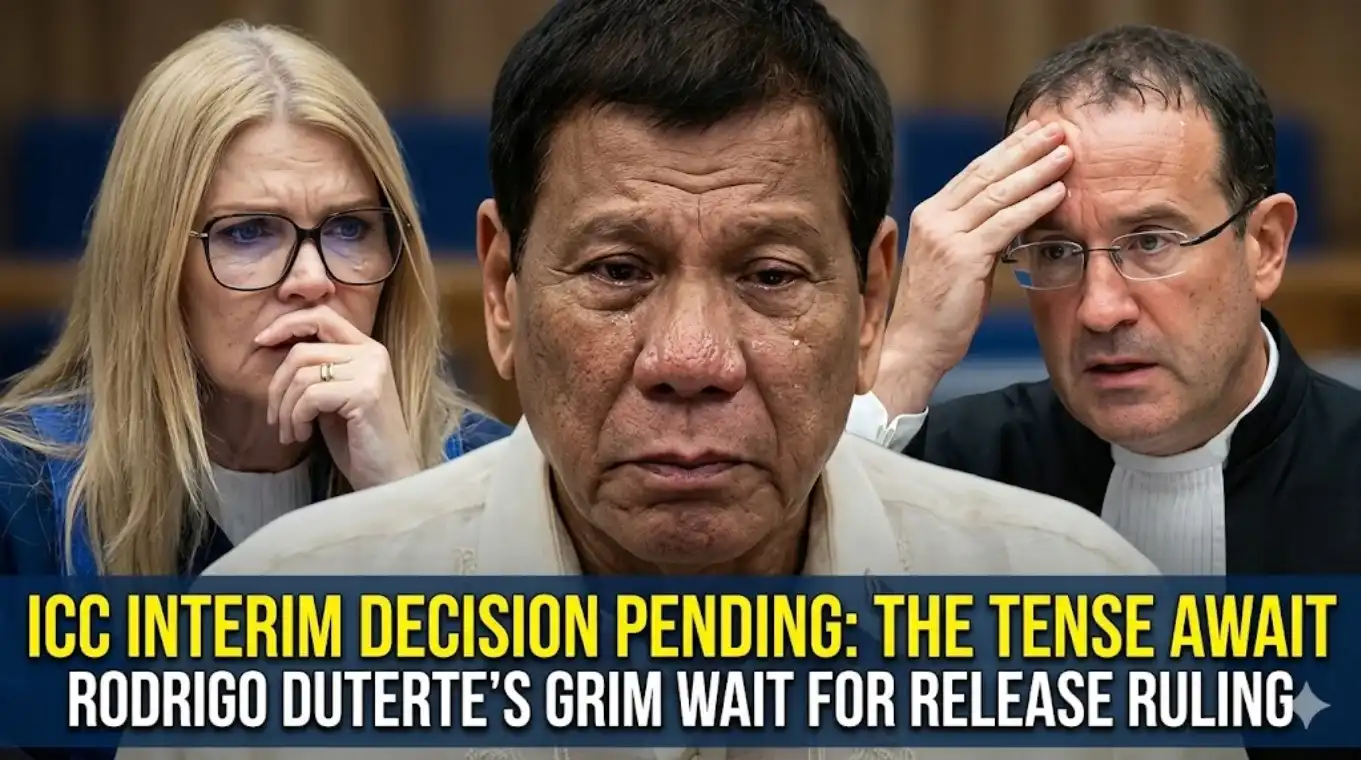
THE HAGUE — The international legal battle that has captivated the Philippines for years reached a fever pitch this week as the International Criminal Court (ICC) concluded its confirmation of charges hearing against former President Rodrigo Duterte.
While the legal arguments regarding the controversial “war on drugs” were complex, one figure cut through the noise to dominate the headlines and Filipino social media feeds alike: Presiding Judge Iulia Antoanella Motoc.
As the Pre-Trial Chamber I begins its critical deliberation phase—a sixty-day countdown that will determine the future of the former President—public opinion in the Philippines has exploded. The discourse has shifted from mere political bickering to a profound national debate on accountability, sovereignty, and the strict courtroom demeanor of the magistrate now colloquially known to netizens simply as “Judge Julia.”
The Hearing That Stopped a Nation
On Friday, February 27, 2026, the four-day confirmation of charges hearing officially wrapped up. This was not yet a trial, but a preliminary examination to decide if there is sufficient evidence to commit the case to a full trial.
For supporters of the former President, the hearing was viewed as an intrusion on national sovereignty. For the families of victims and human rights advocates, it was a long-awaited moment of reckoning.
However, the proceedings took an unexpected turn when the focus shifted to the dynamic between the bench and the defense. Judge Motoc, a Romanian jurist with a formidable background in international human rights law, wasted no time in establishing control over the proceedings.
Her directive to the defense team, led by lawyer Nicholas Kaufman, was clear: respect the chamber’s protocols. This specifically referred to the protection of witnesses and victims, a sensitive issue that sparked immediate reactions back in Manila.
The “Julia” Factor: A New Figure in Filipino Discourse
In the age of viral news, Judge Iulia Motoc has become an unlikely protagonist in Philippine social media. Clips of her presiding over the court—interrupting lengthy diatribes to demand focus and strictly enforcing redactions to protect witness identities—have garnered millions of views.
Netizens have been quick to dissect her background, finding a resume that commands respect. Before taking her seat at the ICC, Motoc served as a judge at the European Court of Human Rights and the Constitutional Court of Romania. Her career has been defined by a rigorous adherence to human rights statutes, a detail that has emboldened critics of the drug war while alarming the former President’s camp.
The “Julia Effect” on public opinion is tangible. For years, the ICC was an abstract concept to many Filipinos. Judge Motoc has given it a face and a voice—one that is stern, unyielding, and focused purely on the legal merits of the evidence presented.
Inside the Courtroom: Substance Over Theatrics
The final days of the hearing saw intense exchanges. The prosecution, led by Julian Nicholls, reiterated its core thesis: that the thousands of deaths during the police operations were not random byproducts of law enforcement, but the result of a state-sponsored policy instigated by Duterte’s rhetoric.
Nicholls argued that the “Davao model”—a system of extrajudicial enforcement allegedly perfected during Duterte’s time as mayor—was replicated on a national scale. The prosecution presented videos, transcripts, and witness affidavits to build a “causal nexus” between the President’s public orders to “kill” and the subsequent actions of police officers on the ground.
In rebuttal, the defense argued that there was no “smoking gun.” Kaufman insisted that the prosecution relied on “dramatic quotations” rather than written orders. He argued that the former President’s speeches were hyperbole, typical of political rhetoric, and did not constitute operational commands.
This is where Judge Motoc’s influence was most felt. By steering the proceedings away from political grandstanding and focusing on evidentiary thresholds, she forced both sides to clarify their legal standing. Her warning to the defense regarding the inadvertent disclosure of sensitive information highlighted the Court’s priority: the safety of the victims participating in the process.
The Explosion of Public Opinion
Back in the Philippines, the reaction has been polarized but engaged.
Social Weather Stations (SWS) and other polling firms have noted a shift. Where once there was fatigue regarding the drug war narrative, the tangible nature of the ICC hearings has reignited interest.
The “Pro-Accountability” Block: Civil society groups and families of EJK (extrajudicial killing) victims have expressed cautious optimism. The visibility of the proceedings has validated their years of struggle. For them, Judge Motoc’s firmness signals that the ICC is not merely a bureaucratic entity but a functioning court of law capable of challenging powerful figures.
The “Sovereignty” Defenders: Conversely, supporters of the Duterte administration maintain that the ICC has no jurisdiction, citing the Philippines’ withdrawal from the Rome Statute. However, legal experts have repeatedly clarified that the Court retains jurisdiction over crimes committed while the country was a member. The defense’s participation in the hearing, despite the political stance of non-cooperation, has confused some supporters but also indicated a recognition of the legal threat the case poses.
The Warning Signs for the Defense
Legal analysts observing the proceedings from Manila and The Hague have pointed out several “warning signs” for the defense team.
First was the Chamber’s refusal to grant interim release or relax conditions prior to the hearing. Second was the strict scrutiny applied to the defense’s arguments regarding the “war on drugs” as a legitimate law enforcement operation.
Judge Motoc and her colleagues—Judges Reine Alapini-Gansou and Socorro Flores Liera—focused heavily on the systematic nature of the killings. The defense’s inability to present a counter-narrative that explained the sheer volume of deaths without implicating state policy appeared to be a significant hurdle.
Moreover, the “incubation” argument raised by the defense—that the ICC took too long to investigate—was met with the counter-argument that the delay was largely due to the Philippine government’s own attempts to stall the probe.
Consequences: The 60-Day Countdown
The conclusion of the hearing marks the start of a tense waiting period. Under Regulation 53 of the Court, the Pre-Trial Chamber has sixty days to deliver its written decision.
This places the decision timeline roughly around late April 2026. The consequences of this decision will be seismic for the Philippine political landscape.
Scenario A: Confirmation of Charges If Judge Motoc and her chamber confirm the charges, Rodrigo Duterte will be committed to trial. This would be a historic first for a Southeast Asian leader. It would trigger the constitution of a Trial Chamber and likely lead to the issuance of further orders regarding custody. The political ripple effects would be immediate, potentially affecting the alliances for the upcoming 2028 national elections.
Scenario B: Declining to Confirm If the judges find the evidence insufficient, the charges could be dropped, and the proceedings stopped. This would be a massive political victory for the Duterte camp, validating their claims that the case was “baseless.” It would likely embolden his political allies and reshape the opposition’s strategy.
Scenario C: Adjournment for Further Evidence The judges could also choose a middle path: adjourning the hearing to request the Prosecutor to provide additional evidence or to amend the charges. This would prolong the legal agony for both sides, keeping the issue in the headlines without offering a definitive resolution.
A Nation in Wait
As the sixty-day clock ticks, the Philippines remains a nation in wait. The arguments have been made, the evidence submitted, and the defense heard.
The figure of Judge Julia Motoc now looms large over the archipelago’s political future. Her gavel, once it falls, will not just decide a legal case; it will define the legacy of a controversial administration and the future of international justice in the region.
For now, the public opinion that has “exploded” shows no sign of cooling down. The livestream clips continue to circulate, the debates rage in comment sections, and the country watches The Hague with bated breath.
Frequently Asked Questions (FAQs)
Q: Who is Judge Julia Motoc? A: Judge Iulia Antoanella Motoc is a Romanian judge serving at the International Criminal Court (ICC). She is the Presiding Judge of the Pre-Trial Chamber I, which handles the case regarding the Philippines. She previously served on the European Court of Human Rights and is a professor of international law.
Q: What happened on February 27, 2026? A: The ICC concluded the “confirmation of charges” hearing against former President Rodrigo Duterte. This was a four-day proceeding to determine if there is enough evidence to send the case to a full trial.
Q: Did former President Duterte attend the hearing? A: No. The former President waived his right to be present at the hearing in The Hague. He was represented by his defense counsel, Nicholas Kaufman.
Q: What happens next after the hearing? A: The judges have 60 days to deliberate. They will issue a decision to either (1) confirm the charges and send the case to trial, (2) decline the charges and stop the proceedings, or (3) adjourn to ask for more evidence.
Q: Can the ICC arrest the former President? A: The ICC has already issued an arrest warrant. If the charges are confirmed and the case moves to trial, the Court will continue to seek his custody to ensure he appears for the trial, as the actual trial cannot proceed in absentia under ICC rules (though confirmation hearings can).
Q: Why is the public reaction so strong? A: The case involves the “war on drugs,” which is a deeply polarizing issue in the Philippines involving thousands of deaths. The strict handling of the hearing by Judge Motoc has also gone viral, sparking renewed debate about justice and accountability.